Over 8,800 food boxes distributed to families at 98 Seattle Public Schools sites
When federal funding for the Supplemental Nutrition Assistance Program (SNAP) abruptly lapsed on Nov. 1 due to the Trump administration’s refusal to release dollars from SNAP’s contingency fund during the partial government shutdown, tens of thousands of Seattle families suddenly faced the loss of a critical monthly benefit.
SNAP provides more than $16 million per month in food assistance to over 50,000 Seattle households, supporting roughly 71,000 low-income residents with an average benefit of $177 per person. For many families, these dollars determine whether they can reliably put food on the table.
Recognizing the urgency, Mayor Bruce Harrell proclaimed a limited civil emergency on Oct. 30 to authorize up to $1 million per week in emergency food assistance, supporting City-contracted food banks, community-based providers, and direct food box distribution efforts until federal support was restored three weeks later. A major component of the effort focused on reaching SNAP eligible students and families through Seattle Public Schools (SPS).
Why Schools Played a Central Role
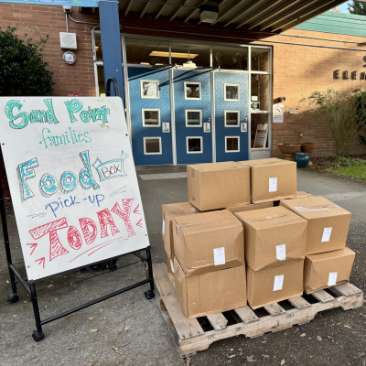
Schools are among the most trusted, stable, and universally accessed institutions in any neighborhood; they are places where families already go every day and where educators know their communities well.
Since 2018, the OSE and SPS Culinary Services have partnered through the Healthy Food in Schools Initiative to expand access to fresh, healthy, culturally relevant, and local food in school meal and snack programs. That partnership proved invaluable during COVID-19, when schools became central hubs for emergency food distribution, and was critical for this year’s rapid response.
Through a tightly coordinated partnership, OSE, the Seattle Department of Education and Early Learning (DEEL), SPS, and Cascadia Produce, 8,800 food boxes were distributed to families at 98 SPS sites over three weeks. Each box contained approximately 20 pounds of food and included a mix of shelf stable pantry items such as rice and beans and produce from local farmers.
Cascadia prepared the boxes and SPS quickly disseminated strategically crafted distribution plans to principals and empowered school-based teams, including Family Support Workers and social workers, to distribute food to families in ways that reduced stigma and aligned with the rhythms of each school community.
At the same time, SPS Culinary Services leveraged its operational infrastructure, including its central kitchen, loading docks, food service staff, and delivery trucks, to receive food boxes and move them across the city swiftly and safely.
A Coordinated City–School–Supplier Partnership
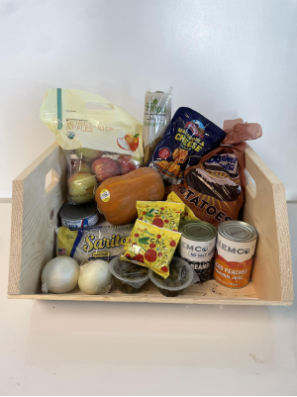
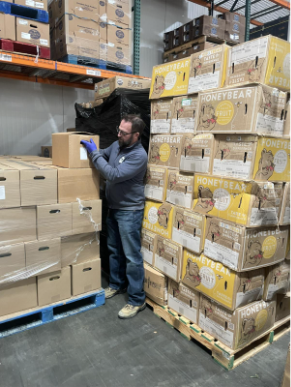
This rapid response effort was further strengthened by a close partnership with Cascadia Produce, a local produce distributor and long-standing partner in regional food security efforts. Cascadia Produce assembled the food boxes which contained shelf stable items and healthy snacks and hearty produce from Washington farms whenever possible, providing an economic boost to local growers at the end of the season.
Yakama Nation (Wapato, WA) provided several types of hard squash and onions. Carrots came from Four Elements (Puyallup, WA) and Hayshaker Farm (near Walla Walla, WA). Apples and dried cherries came from Rowley & Hawkins Fruit Farms (near Othello, WA). Boxes also included potatoes from Baker Produce (Pasco, WA).
Boxes were delivered to the SPS central kitchen, where SPS staff repalletized them or transferred the boxes from receiving pallets to new pallets tailored for school-by-school delivery.
Over the three-week response period, this coordinated system delivered more than 8,800 food boxes directly to families most impacted by the SNAP delay.
A Resilient Local Food System in Action
This rapid emergency response showcased a highly coordinated partnership between OSE, SPS, and Cascadia Produce, a local food supplier. City leadership, school district and school staff, and a Cascadia Produce came together with speed, coordination, and a shared commitment to ensure families had what they needed during a politically driven disruption to a lifeline program.
Seattle’s response over these three weeks reflects a city determined to protect its residents, uphold food security, and demonstrate what a resilient and community-rooted food system looks like in action—no matter what’s happening in Washington D.C.
On Saturday, Nov. 22, 2025, Mayor Bruce Harrell lifted the limited Civil Emergency.
Quotes from Partners and School Leaders
“The boxes met the needs for our families during an uncertain time. Also – we had an amazing group of parent volunteers distributing the boxes.”
SPS Principal
“This has been extremely beneficial to our school families who have food insecurity. The food delivered on Week 2 had the perfect ingredients to make a meal at home. Thank you on behalf of our school families. Basic needs of rice, beans, onions, carrots and potatoes are perfect.”
SPS Principal
“As a small business in Washington, we were honored to be able to work alongside other small businesses and local farmers to make sure that those who were put in harm’s way had their needs filled, and also farmers were supported and families were fed.”
Jeremy Vrablik, Owner of Cascadia Produce